News
Jaguar XE vs BMW 3 Series
The BMW 3 Series has been Britain's most popular executive saloon for years and it's still one of the best. However, the new Jaguar XE has lower CO2 emissions and more standard equipment, so does it make even more sense?
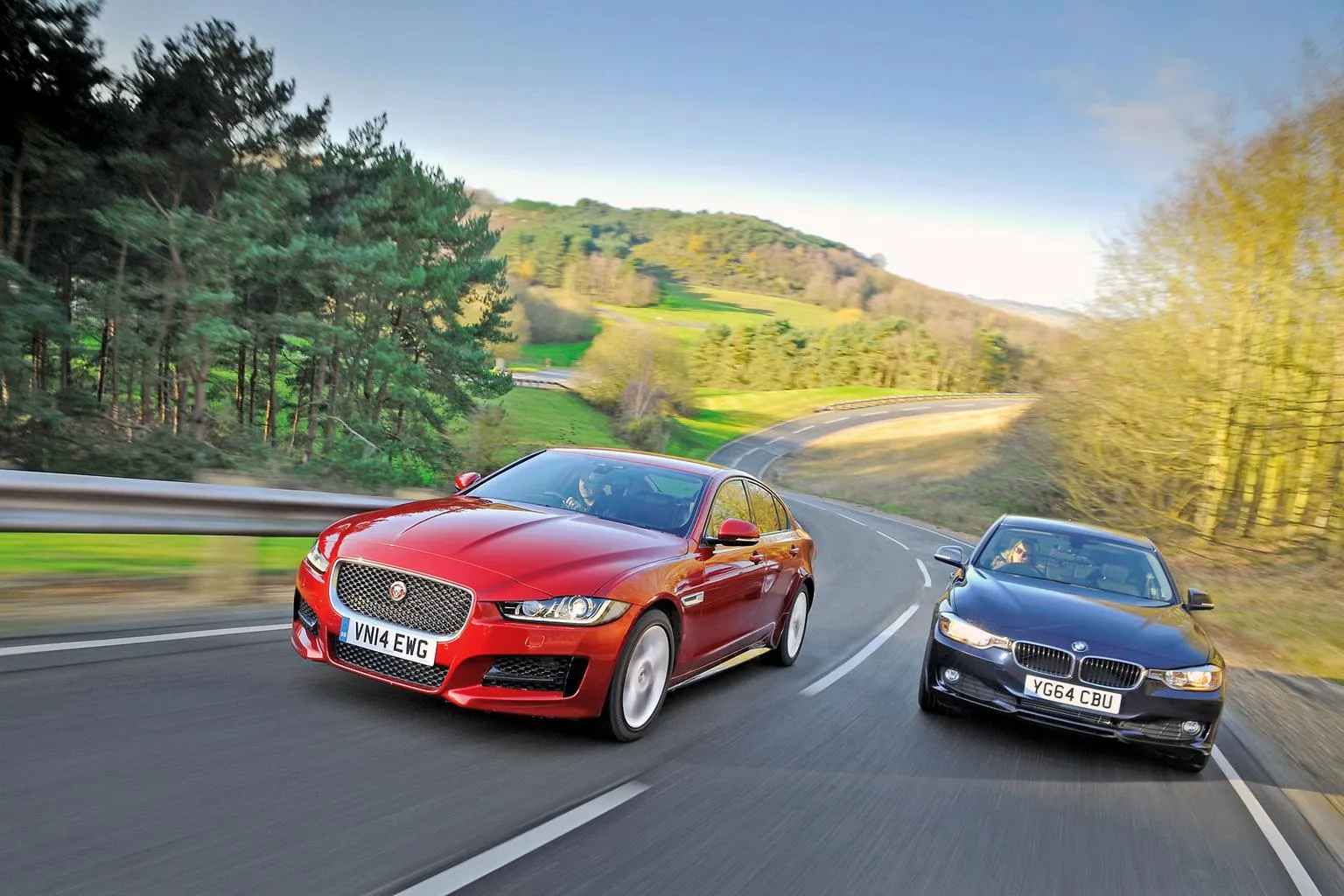
Few cars whip up as much hype on these shores as a new Jaguar. The company might not be British-owned these days but there’s still a lot of Britishness in the way it’s run, with all models designed and built here.
advertisement
scroll for more
Usually, though, any excitement has to be tempered with some rather more sobering realities. Jags tend not to lead their respective classes on fuel economy, for example, and because they tend to depreciate quicker than their German rivals they often end up costing you more in the long run.
Until now, that is. The new Jaguar XE isn’t just super-desirable, you see, it also makes a surprising amount of sense financially. In fact, if you’re a company car driver – as most premium saloon 'owners' are – it’ll cost you less to run than an equivalent BMW 3 Series.
What are they like to drive?
We’re testing the most efficient versions of these cars, and that means they’re both powered by 161bhp 2.0-litre diesel engines. You might imagine there would be little to split the two for performance, but you won’t have to drive far to realise the BMW accelerates with a fair bit more vigour. That’s not only the case when you rev the engine hard; it’s also true when you want to build speed from low revs in higher gears.

Steve Huntingford
Updated: 5 February 2015
Car reviews
View all new car reviews
advertisement
scroll for more
The longer-geared XE rarely feels sluggish, mind, and its engine is happy to sit at very low revs without labouring. You just need to think a bit further ahead when planning overtakes or when accelerating down a motorway slip road.
That’s about our only criticism with the way the XE drives, though. It outshines the BMW on twisting roads, darting into bends more eagerly, and staying flatter and more composed. The Jag grips harder, too, and has steering that’s quick and precise without making the car feel nervous at high speeds. That’s important given the high number of motorway miles many executive car buyers rack up.
Not that the 3 Series is even remotely sloppy. It still handles sweetly and its steering, although slower than the Jag’s, actually streams a bit more information to your fingertips. However, the relatively high-walled tyres fitted to our Efficient Dynamics test car could do with more grip – especially in the wet.
Fortunately, the XE’s sporty handling doesn’t come with a bone-shaking ride. In fact, the Jag is remarkably comfortable. It’s firm, but supple enough to take the sting out of potholes in town, and stays wonderfully settled on the motorway. We’d recommend avoiding R Sport models, though, since they come with lower and stiffer suspension, so aren’t as comfortable.
advertisement
scroll for more
Our 3 Series test car was fitted with optional Adaptive M Sport suspension (£750). This gives you the option to stiffen and soften the dampers by pressing a button. Switch to Comfort mode and the BMW’s ride is even more forgiving than the Jag’s at low speeds, although the 3 Series doesn’t feel as well tied down over high-speed dips and crests.
Journeys are more peaceful in the XE, with less wind and engine noise finding its way into the cabin. By contrast, the 3 Series’ engine blurts out quite a racket when revved and, although there is less road roar at motorway speeds, the BMW has the notchier manual gearshift.
What are they like inside?
Whatever your size or shape, you’re unlikely to have much trouble finding a comfortable driving position in either of these cars. That said, it’s easier to adjust the Jag’s seats thanks to part-electric movement, whereas tweaking the BMW’s is a comparatively fiddly process because you have to pull a lever and shift your weight around. The 3 Series’ pedals are offset a bit too far to the right, too, which forces you to sit at a skewed angle much of the time.
advertisement
scroll for more
There’s little to split the two rivals for interior quality, with plenty of soft-touch materials in all the important areas. If anything, the XE’s cabin is bolted together a bit more precisely, with smaller and more consistent gaps between the different sections of the dashboard. Then again, the BMW’s switches, knobs and buttons feel that bit more substantial.
The XE is the first model to have Jaguar’s new InControl infotainment system. It’s a massive improvement over the company’s older systems because it’s not only a lot more intuitive, it’s also much quicker to respond to commands. It’ll sync with your Smartphone to give you access to some handy apps, too, including one that’ll display your phone’s calendar and another that searches out nearby hotels.
That said, it’s still a touchscreen, so you do have to concentrate to make sure you’re pressing the correct area of the display. That’s not ideal when you’re driving.
advertisement
scroll for more
Performing certain functions – such as changing the radio station or tapping a postcode into the sat-nav – is easier in the BMW. That’s because iDrive features a big rotary dial and a selection of shortcut buttons positioned between the front seats, and requires less concentration.
Neither car is particularly spacious as premium saloons go. You’ll want to look at larger executive cars such as the Audi A6 and BMW 5 Series if you regularly carry adults in the back. That said, the 3 Series is the roomier of the two, with more legroom in the back and a bigger boot. The latter’s extra width is very handy, making it easier to slot in a set of golf clubs or a buggy. Split-folding rear seats are an option on both.
What will they cost?
The XE is one of only a handful of premium saloons that pumps out less than 100g/km of CO2.
That’s a good thing for the environment but it’s also great news for company car drivers because it translates to sizeable tax savings. Each month you’ll sacrifice £17 a month less of salary to run the Jag than the BMW, which adds up to a hefty £600 over three years.
advertisement
scroll for more
That’s only the case if you stick with a manual gearbox, however. Go for an auto (£1550 extra on
the 3 Series and £1750 on the XE) and the Jag’s emissions jump to 106g/km, whereas BMW’s remain at 109g/km, levelling the playing field.
If you’re buying privately the 3 Series has the edge.It's cheaper to start with, and while BMW dealers are willing to cough up discounts of more than £2200, the XE will be available with much smaller savings for at least for the first few months. It counters with slower depreciation but it’ll still work out slightly more expensive to own than the BMW – assuming you buy now and sell after three years.
Real-world fuel economy is one reason for this; the Jag averaged 3.5mpg fewer than its German rival in our tests. However, our test XE was an early-build car that didn’t have a functioning engine stop-start system, so you can probably expect slightly more than the 50.7mpg we managed.
You’ll need to spend several hundred pounds if you want your 3 Series to be as well-equipped as the XE. Both cars come with leather seats, sat-nav, cruise control, heated seats, rear parking sensors, automatic lights and wipers, and cruise and climate controls. The XE adds bigger alloy wheels and automatic emergency braking.
advertisement
scroll for more
Our verdict
Jag’s new XE just edges the 3 Series. It’s even more fun to drive than its German rival, better equipped and cheaper to run as a company car, so unlike Jaguars of old it makes as much sense to the head as it does the heart. That said, its victory could well be short-lived because an updated 3 Series goes on sale later this year with CO2 emissions that match the XE’s. Until then, though, the XE is one of the very best executive saloons.
1st - Jaguar XE 2.0d 163 Prestige
For Brilliant handling; comfortable ride; lots of kit; low CO2 output
Against Cramped rear; so-so performance; small fuel tank
Verdict Finally, a Jaguar you can buy with your head
2nd - BMW 320d ED Business Edition
For Supple ride; more spacious; brilliant infotainment
Against Noisy engine; higher BIK; no automatic braking
Verdict Still a fine car, but we'd wait for the face-lift
BMW 3 Series
Engine size
2.0-litre diesel
Price from
£30,175
Power
161bhp
Torque
280lb ft
advertisement
scroll for more
0-62mph
7.7 seconds
Top speed
143mph
True MPG
54.2mpg
CO2
109g/km
- Test car did not have a correctly functioning stop-start system
Jaguar XE
Engine size
2.0-litre diesel
Price from
£30,775
Power
161bhp
Torque
280lb ft
0-62mph
9.1 seconds
Top speed
132mph
True MPG
50.7mpg*
CO2
99g/km
News and advice
News
Kia PV5 Cargo and Chassis to be eligible for Plug-in Van Grant
Sponsored
The 10 fastest-depreciating electric cars
News
New Lotus hybrid supercar to arrive in 2028 powered by 671bhp V8 engine
News
Peugeot 208 and 2008 gain new mid-spec Envy trim for £23k
Feature
20 years of Qashqai: the model that started the family crossover revolution
Feature